WHAT I TEACH / HOLDING SPACEHolding Space: The Most Under-taught Skill in Holistic Esthetics
Your nervous system is part of the treatment. This is the work that changes everything else.
There is a skill that no esthetics school curriculum includes, that almost no CE program addresses, and that every experienced practitioner eventually learns through accumulated years of being in the room with people — often through mistakes, burnout, or a client experience that stays with them for a long time.
It's the skill of holding space.
Knowing how to be present with someone. Knowing how your nervous system affects theirs. Knowing what to do when someone starts to cry on your table, when someone discloses something difficult, when you walk into a session carrying something heavy of your own. Knowing the difference between empathy that connects and empathy that depletes.
This is not soft skills. This is the technical foundation of a therapeutic practice. And I believe it should be taught as rigorously as any massage technique.
What Is Space-Holding in an Esthetic Context?
The term 'holding space' is used broadly enough that it has lost some precision. In the context of professional esthetic practice, I define it specifically: holding space is the practitioner's ability to maintain regulated nervous system presence so that the client's system can rest, process, or release within the safety of the treatment container.
This is not about having the right words. It is not about being calm in a performed sense. It is about your actual physiological state — the quality of your breathing, the quality of your attention, the groundedness of your own system — and how that state transmits, through the therapeutic relationship, to your client's system.
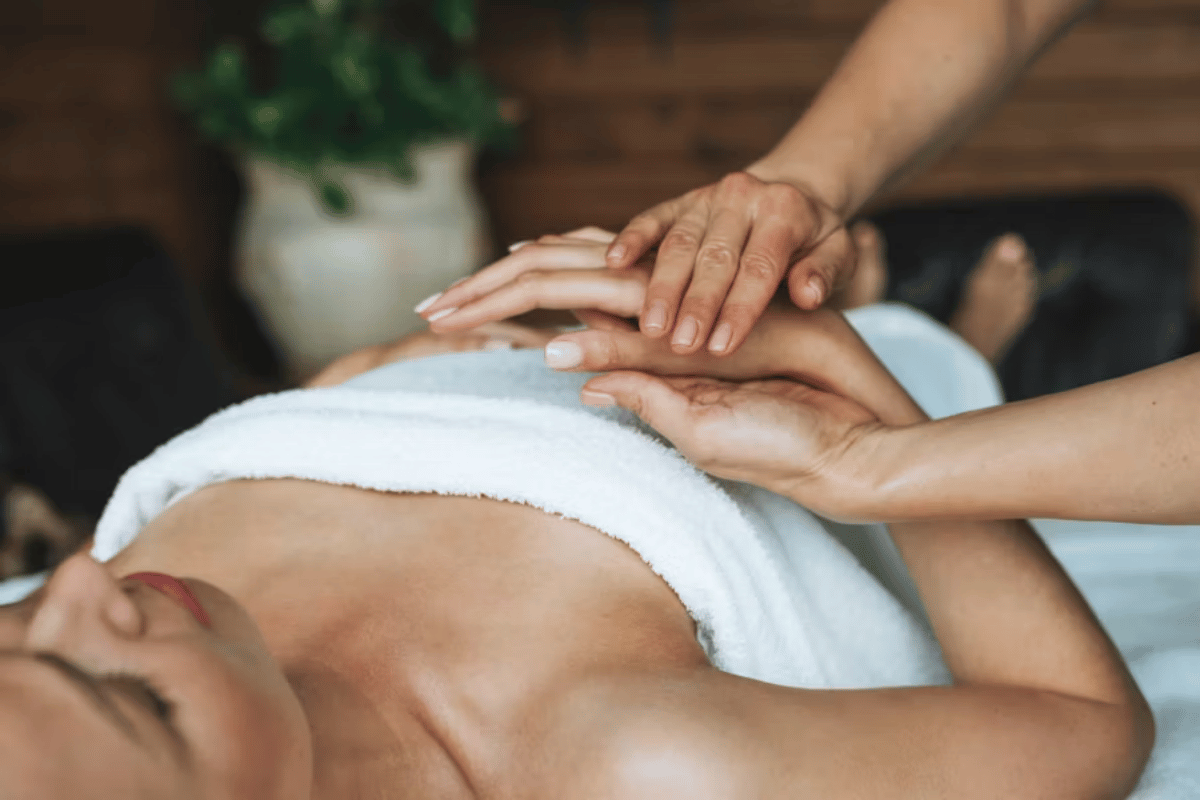
Touch is a profoundly regulating — or dysregulating — experience. When you place your hands on someone, you are not just applying technique. You are transmitting the state of your nervous system to theirs. Skilled practitioners have always known this intuitively. Now we have the neuroscience to explain it: polyvagal theory, interoception, co-regulation, the research on therapeutic touch and oxytocin release.
Understanding this mechanism is not optional for a holistic esthetician. It is the foundation of everything else.
Why This Belongs in Esthetic Education
Holistic esthetics attracts practitioners who want to do more than clean pores. They want to create genuine therapeutic experiences. They want their clients to feel seen and cared for in a way that goes beyond product results.
And then they get in the room and realize they don't have a framework for the non-technique parts of the session. What do you do when a client cries? What do you say when someone discloses trauma? How do you set a limit with a client who needs more from you than you can give? How do you show up for ten clients in a row without fragments of their energy accumulating in your system?
These questions don't have simple answers. But they have learnable frameworks — and practitioners who have those frameworks are safer for their clients, more sustainable in their practice, and more effective at the work they came to do.
Key Concepts in the Holding Space Curriculum
Polyvagal Theory for Practitioners
Polyvagal theory, developed by Dr. Stephen Porges, offers the most useful framework I've found for understanding what happens in a therapeutic relationship. It explains why nervous system safety — not just the absence of threat, but the active presence of signals of safety — is the precondition for healing. It explains why the quality of your presence matters more than any technique. And it gives practitioners a language for what they've always sensed but couldn't articulate.
Co-Regulation and the Therapeutic Relationship
Co-regulation is the biological process by which nervous systems regulate each other — primarily through social cues, proximity, touch, voice, and breath. It is the mechanism by which a calm practitioner creates the conditions for a client's system to calm. Understanding co-regulation changes how you prepare for sessions, how you transition between clients, and how you understand your role in what happens on the table.
Your Own Nervous System as the Primary Tool
Before any technique, before any product, the most important thing you bring into the treatment room is the state of your own system. A practitioner who is dysregulated — anxious, depleted, rushed, or holding something difficult — transmits that state. Learning to regulate yourself — through breath, through embodied presence practices, through the structures that support your capacity to show up — is not self-care in the lifestyle sense. It is clinical practice.
Ethical Boundaries and Scope
Holding space does not mean providing therapy. One of the most important things I teach in this curriculum is the distinction between therapeutic presence (within scope) and therapeutic intervention (outside scope). Knowing how to receive what a client brings without taking it on, and knowing when and how to refer, is essential professional skill.
Practitioner Sustainability
Burnout among holistic practitioners is epidemic. It doesn't come from caring too much — it comes from caring without a container. The holding space curriculum includes practices for decompressing between sessions, resourcing yourself after difficult appointments, and building a practice structure that supports your own capacity over time.

This Is the Work Beneath the Work
I came to this material through my training in somatic modalities — yoga, sound healing, Ayurvedic bodywork — and through years of being in the room with people who were tender, in process, or coming apart at the seams. I've made the mistakes. I've felt the depletion. And I've found the practices that create sustainability.
I teach this because I believe it's what separates a practitioner from a technician. And because the world needs more practitioners who can truly be present — not performing presence, not managing clients, but actually there, in the room, available to what is.
What You'll Learn
Polyvagal theory fundamentals and their application to the treatment room
The science of co-regulation and how your nervous system state affects your clients
Practices for self-regulation before, during, and after sessions
How to respond to emotional release in the treatment room — what to say, what not to say, and what to do
Ethical scope considerations: the difference between holding space and providing therapy
Practitioner sustainability practices and decompression protocols
How to create intake language and treatment room structures that support client safety
Ready to Go Deeper?
→ Explore upcoming workshops and courses (tendingpractice.com/workshops)
→ See all modalities in the Tending Practice curriculum (tendingpractice.com/what-i-teach)
Frequently Asked Questions
Isn't this more appropriate for therapists or counselors than estheticians?
This is exactly the kind of question this curriculum is designed to address. No — holding space for what arises in a therapeutic touch session is not therapy. It is part of the practitioner role in any hands-on healing practice. The curriculum teaches the version that belongs to esthetics specifically, including scope of practice distinctions and referral practices.
What if I'm not naturally a very emotionally intuitive person?
This curriculum is not about emotional intuition — it's about frameworks and practices. Nervous system regulation is a skill that can be learned and practiced. You don't have to be naturally empathic to become a skilled space-holder. You do have to be willing to learn.
What happens if a client starts crying during a treatment?
This is one of the most common things that happens in holistic facial work — and one of the things most estheticians feel least prepared for. The curriculum addresses this directly: what to do in the moment, what to say (and what not to say), how to follow the client's lead, and how to close the session in a way that feels complete and safe.
How does this relate to the other things you teach?
Everything else in the Tending Practice curriculum — Ayurvedic facials, marma work, advanced massage, herbalism — is made more effective by skilled space-holding. It is the container within which the techniques work. I teach it as foundational to the whole curriculum.
I've been practicing for years and never thought about this. Is it too late to learn?
It is never too late. In fact, experienced practitioners often find this curriculum the most immediately transformative — because you already have enough practice context to understand exactly how it applies to what you do. Many long-practicing estheticians say it reframes their entire career.