The History of Marma Point Therapy: Ancient Medicine in the Modern Treatment Room
There is a moment that happens in every marma point workshop I teach. We're about twenty minutes into the hands-on practice, the room has gotten quieter than it was at the start, and someone looks up from their partner's face with this expression — somewhere between amazed and unsettled — and says: 'What just happened?'
What happened is that they pressed their fingertip into a precise point just lateral to the nostril and held it with sustained, intentional pressure for about forty-five seconds. Their partner's breathing slowed. Their shoulders dropped. Their face, which had been holding the particular kind of tension that faces hold when they're trying to look relaxed, actually relaxed.
That point is called Phana. It has been mapped, named, and worked with therapeutically for at least three thousand years. And it will do that every single time, with every single client, if you know where it is and how to use it.
This post is about where marma therapy comes from, why it works, and why it belongs in your treatment room even if you've never heard of it before today.
What 'Marma' Actually Means
The Sanskrit word 'marma' is typically translated as 'vulnerable' or 'secret.' In the Ayurvedic tradition, marma points are defined as the places where two or more types of tissue meet — muscle, vein, ligament, bone, and joint — and where prana, the vital life force, concentrates and flows. They are considered the seats of life: the most alive, the most sensitive, and the most powerful points in the body.
The classical Ayurvedic texts identify 107 marma points across the entire body. Of these, 37 are located on the face and head — a remarkable density, and one that reflects the Ayurvedic understanding of the head as the site of the highest concentration of prana in the body. The skull houses the brain. The face houses all five sensory organs. The head is, in Ayurvedic medicine, the primary seat of consciousness.
Working with the marma points is not, in the original tradition, a beauty practice. It is a medical one. Marma therapy has its roots in Ayurvedic surgery, military medicine, and the treatment of trauma — and the sophistication of its original application is humbling when you encounter it.
The Sushruta Samhita and the Origins of Marma Science
The primary classical source for marma point knowledge is the Sushruta Samhita, one of the two great foundational texts of Ayurvedic medicine, attributed to the physician Sushruta and dated to approximately 600 BCE — though it is likely a compilation of knowledge that had been transmitted orally for centuries before it was written down.
Sushruta is considered the father of surgery. The Sushruta Samhita describes hundreds of surgical procedures, instruments, and techniques with a level of anatomical precision that astonished Western scholars when these texts were translated in the 18th and 19th centuries. Rhinoplasty. Cataract surgery. Cesarean section. The reconstruction of severed earlobes. These procedures are described in detail, with aftercare protocols, in a text written two and a half millennia ago.
Within this context of surgical medicine, the marma points were first systematically mapped — and they were mapped as a warning. Surgeons-in-training were required to memorize the location of all 107 marma points so they would know where not to cut. These are the places where injury is most dangerous, where the disruption of prana flow is most likely to cause serious harm or death.
The therapeutic application of the marma points — the understanding that these same points could be stimulated to promote healing, balance, and wellbeing — developed from this anatomical foundation. The same knowledge that told surgeons where not to cut told healers where to touch.
The 37 Points of the Face and Head
Of the 107 classical marma points, the 37 located on the face and head are organized into functional groupings that correspond to specific body systems and organs. This is not metaphor or approximation — it is the result of generations of careful clinical observation, refined over centuries of practice.
The brain and nervous system points
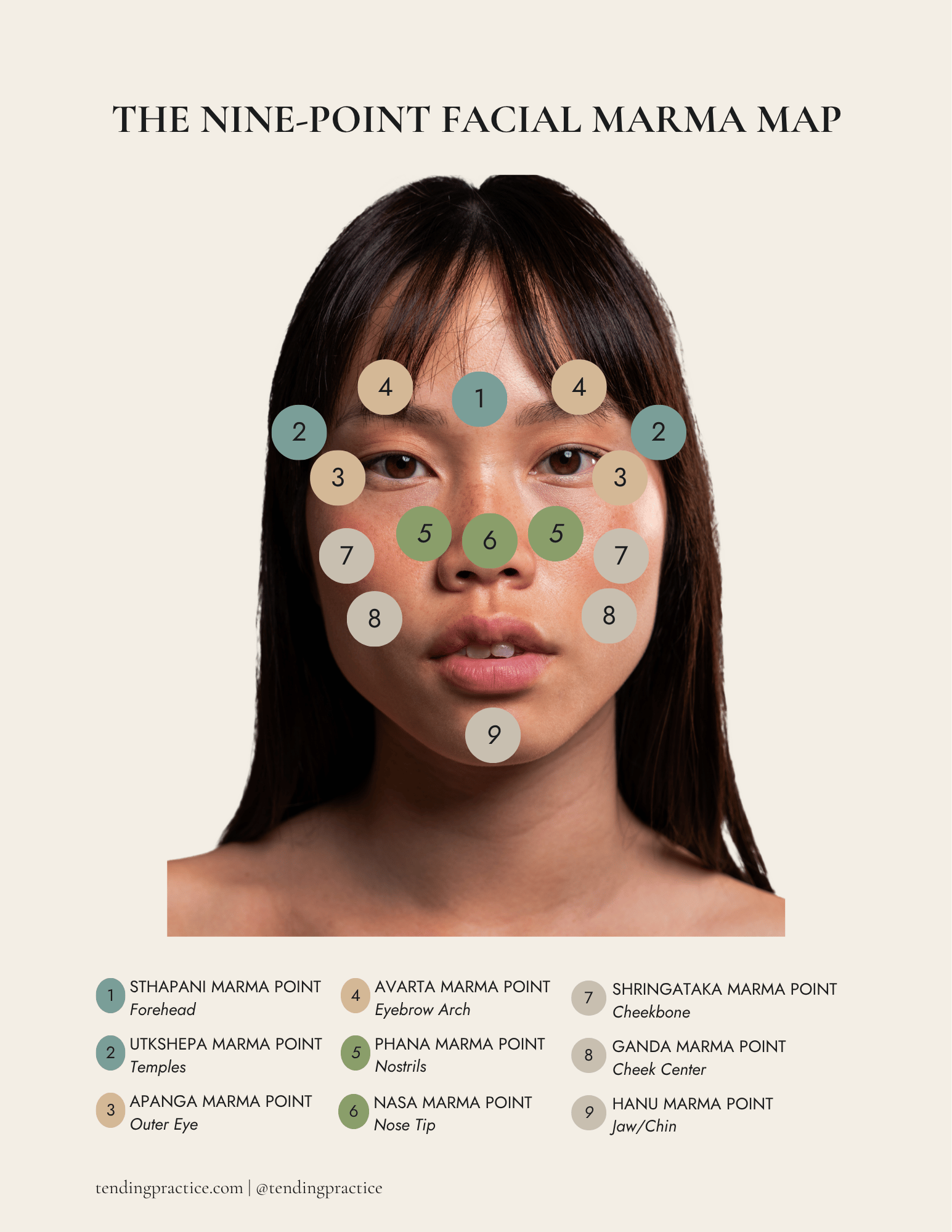
The most significant of these is Adhipati, located at the crown of the head — the apex of the skull, the seat of higher consciousness in Ayurvedic thought. Below it is Simanta, a complex of points running along the cranial sutures. At the center of the forehead is Sthapani, the 'third eye' point, which is the anchor of virtually every marma facial sequence and which has a profound effect on the nervous system when held with sustained, steady pressure.
These points are worked with at the beginning and end of a marma sequence — Sthapani to open and integrate, Adhipati to close and ground. They create the container within which all the other work happens.
The sensory organ points
Apanga sits at the outer corner of each eye, corresponding to the liver and visual system. Avarta sits just above and lateral to the eyebrow, influencing the eye itself and the frontal sinuses. Shankha occupies the temples — the most significant accumulation sites for Pitta in the head, where tension from mental overwork, unprocessed emotion, and excess heat tends to pool.
Anyone who has ever had a headache centered in the temples knows what Pitta accumulation feels like. Anyone who has ever had a skilled marma practitioner work those points knows what it feels like to release it.
The lymphatic and sinus points
Phana — the point lateral to the nostrils that I described in the opening — is one of the most reliably effective points for lymphatic clearing in the face. It connects to the nasal mucosa, the maxillary sinuses, and the lymphatic drainage pathways of the mid-face. Clients with chronic congestion, post-nasal drip, or simply the puffiness that accumulates in the mid-face over the course of a day respond dramatically to skilled Phana work.
The nervous system regulation points
Vidhura sits just below and behind the earlobe, over the mastoid process. In the classical literature, it is described as a point whose injury can cause deafness — which tells you something about its anatomical significance. In therapeutic practice, Vidhura is one of the most powerful nervous system regulation points on the face and head, producing a quality of deep calm that clients often describe as unlike anything they've experienced in a facial.
Why These Points Work: The Modern Explanation
The Ayurvedic explanation for why marma points work is energetic — prana flows through channels called nadis, the marma points are nodes in that network, and stimulating them influences the flow of vital force through the whole system. This is a coherent and internally consistent explanation, and it is not one I dismiss.
But for practitioners trained in Western anatomy and physiology, there is also a modern explanation that is equally coherent.
The marma points, when mapped against Western anatomical diagrams, consistently correspond to sites of high anatomical density — nerve plexuses, arterial bifurcations, lymph node clusters, fascial junctions. Phana sits over the infraorbital nerve and the infraorbital foramen. Vidhura sits over the great auricular nerve. Sthapani corresponds to the nasion and the frontal nerve. Shankha overlies the temporal artery and the temporal branch of the facial nerve.
In other words: Ayurvedic physicians, working from careful observation over centuries, identified the same anatomically significant points that Western anatomy has since mapped through dissection and imaging. They arrived there through a different methodology and described what they found in different language — but they were looking at the same territory.
When you hold Sthapani with sustained pressure, you are stimulating the frontal nerve, influencing arterial flow to the frontal cortex, and — through the vagal pathways that run through the face — activating the parasympathetic nervous system. The nervous system slows down. The client's breathing deepens. Their face releases the holding it's been doing all day.
That is not magic. That is anatomy that Sushruta understood three thousand years before we had the language to describe the mechanism.
Marma in the Treatment Room: What It Actually Looks Like
A marma facial sequence is not a rapid technique. The points respond to sustained, intentional pressure — typically 30-90 seconds per point, with a quality of attention that distinguishes this work from ordinary massage. You are not rubbing or stimulating in the conventional sense. You are holding, listening, and waiting for the tissue to respond.
Clients who receive skilled marma work for the first time often describe a sense of the room changing — a deepening of quiet, a release of something they didn't know they were holding. Some cry. Some fall deeply asleep. Some feel buzzing or warmth at the point being held. All of these are normal responses to the activation of the nervous system's parasympathetic branch.
In an Ayurvedic facial, I integrate marma work as a closing ritual — after the cleansing, masking, and massage work is done, the last fifteen minutes are dedicated to a slow progression through the primary facial marma points. This is the part of the treatment that clients remember most. It's the part they come back for.
Learning Marma as an Esthetician: What's Involved
Learning marma point therapy well requires three things: precise anatomical knowledge of point locations, an understanding of the classical context (the what and why of each point, not just the where), and the development of a quality of touch that is quite different from conventional massage technique.
The anatomy can be learned from books and diagrams. The context requires a teacher — ideally one whose training in Ayurvedic medicine includes the source texts, not just the technique. The quality of touch develops through practice, feedback, and a willingness to slow down past the pace most esthetic work operates at.
In my workshops, I teach marma in this order: history and philosophy first (because the points mean more when you understand what they are), anatomy second (location, corresponding systems, clinical significance), and hands-on practice third (with real-time feedback on pressure, duration, and quality of attention). It takes a full day to develop a working foundation. It takes years to develop mastery.
But the working foundation — the ability to integrate the primary facial marma points into your existing practice and produce a consistently different quality of client experience — is accessible to any esthetician who is willing to slow down and learn.
The marma points are not a technique you add to your facial. They are a different relationship with the face entirely. Once you've experienced it, going back feels like a loss.
The Responsibility That Comes With This Work
I want to say something that isn't always said in CE education, and that I think matters enormously: working with the marma points carries a responsibility that ordinary facial massage does not.
These points move things. Not in a metaphorical sense — in a literal, physiological sense. They influence nervous system tone, lymphatic flow, circulation, and the body's capacity to process stored tension. Clients can have significant emotional releases on the table. Clients with certain medical conditions need modified approaches. And practitioners who work with these points while dysregulated themselves — anxious, depleted, distracted — will get inconsistent results at best.
This is why I teach marma within a broader framework that includes holding space, nervous system regulation, and the practitioner's own self-care practice. The technique is the easy part. The presence it requires is the real study.
→ Read about the Marma Point Therapy curriculum (tendingpractice.com/what-i-teach/marma-point-therapy)
→ See upcoming workshops (tendingpractice.com/workshops)
→ Join the Tending Practice Collective (tendingpractice.com/community)