What Is Ayurvedic Skincare? The Complete Guide for Estheticians
Let me guess. You've seen 'Ayurvedic' on a product label — maybe a facial oil, maybe a serum with neem or ashwagandha in it — and you've nodded along like you knew exactly what that meant. And maybe you did, a little. Or maybe, like most estheticians trained in Western protocols, you had a general sense that it was ancient and Indian and probably involved turmeric, and you left it there.
I'm not judging you. I did the same thing for years.
It wasn't until I moved to Portland and started working at an Ayurvedic spa that I realized how much I didn't know — and how radically Ayurvedic philosophy was going to change the way I practiced. Not incrementally. Not as an add-on. Fundamentally. At the level of how I looked at a client's face, what questions I asked, what I believed I was actually doing when I put my hands on someone.
This post is the guide I wish I'd had. It's long because the subject deserves length, and because I think you deserve more than a listicle. Pour yourself something warm and settle in.
The 5,000-Year Context
Ayurveda is a Sanskrit word. 'Ayus' means life. 'Veda' means knowledge. Ayurveda is, literally, the knowledge of life — and it is one of the oldest continuously practiced medical systems on the planet, with documented roots stretching back at least 5,000 years in the Indian subcontinent.
It is not alternative medicine in the way that phrase is usually meant. In the context in which it developed, it was simply medicine — comprehensive, sophisticated, and organized around a set of principles that were remarkably coherent given that they were developed millennia before germ theory, before the discovery of DNA, before we had any of the mechanistic frameworks we now consider basic science.
What Ayurveda figured out, through generations of careful observation, is that human beings are not interchangeable. That the same substance — food, herb, climate, experience — affects different bodies differently. That a treatment protocol that works brilliantly for one person might make another person worse. And that understanding why requires a framework for understanding the individual, not just the condition.
That framework is the tridosha theory, and it is the foundation of everything in Ayurvedic skincare.
The Three Doshas — and What They Have to Do With Skin
In Ayurvedic medicine, all matter — including the human body — is understood as being composed of five elements: earth, water, fire, air, and ether (space). These elements combine in the body to form three biological energies called doshas: Vata, Pitta, and Kapha. Every person has all three doshas present, but in a unique ratio that is established at conception and defines their constitutional type, or Prakriti.
Understanding the doshas is not about labeling your clients. It's about developing a nuanced way of understanding how their body — and their skin — is organized, what it tends toward, and what it needs to come back to balance.
Vata: Air and Ether
Vata is the energy of movement. It governs circulation, respiration, nervous system function, and the movement of waste through the body. People with dominant Vata constitution tend to be lean, quick-thinking, creative, and prone to anxiety and overwhelm when out of balance.
Vata skin is typically dry, thin, and fine-pored. It ages with fine lines and tends to dehydrate quickly — not just from environmental exposure but from internal factors like stress, erratic eating, poor sleep, and overstimulation. When Vata is in excess, the skin looks dull, feels tight, and loses its luminosity. Clients will often tell you they've 'always had dry skin' without connecting it to the nervous system component that's driving it.
Vata skin responds beautifully to nourishing, grounding, warming treatments — rich oils like sesame and almond, slow rhythmic massage that calms the nervous system, and anything that creates a felt sense of safety and warmth in the body.
Pitta: Fire and Water
Pitta is the energy of transformation. It governs digestion, metabolism, body temperature, and the processing of experience — both physical and emotional. People with dominant Pitta constitution tend to be sharp, focused, driven, and prone to inflammation, irritability, and perfectionism when out of balance.
Pitta skin is sensitive, warm-toned, and prone to redness. Rosacea, perioral dermatitis, inflammatory acne, hyperpigmentation after sun exposure — these are classic Pitta skin presentations. The skin is reactive, easily triggered by heat, spicy food, alcohol, and emotional stress. Clients with Pitta skin often describe their skin as 'unpredictable' — fine for weeks and then suddenly flaring.
Pitta skin needs cooling, anti-inflammatory support — rose, sandalwood, neem, coconut oil, and a treatment pace that doesn't overstimulate. These clients benefit enormously from less — less manipulation, less heat, less of everything that turns up the intensity. Gentle, precise, and cooling is the approach.
Kapha: Earth and Water
Kapha is the energy of cohesion and stability. It governs the structure of the body, immunity, lubrication of joints and tissues, and the capacity for sustained effort. People with dominant Kapha constitution tend to be steady, nurturing, and patient — and prone to congestion, sluggishness, and attachment when out of balance.
Kapha skin is thicker, oilier, and more prone to congestion, enlarged pores, cystic breakouts, and a certain heaviness in the tissue. Kapha skin ages more gracefully than Vata or Pitta — it keeps its collagen longer — but it requires regular stimulation to stay clear and vital. Clients with Kapha skin often have products that work well individually but still find their skin feeling sluggish and congested.
Kapha skin responds well to stimulating, detoxifying treatments — dry brushing, herbal poultice work, lymphatic drainage, and lighter oils like sunflower or jojoba that move through the tissue without adding heaviness.
Prakriti vs. Vikriti: The Question That Changes Everything
Here is the concept that most Ayurvedic skincare content skips, and it's the one that matters most for your practice.
Prakriti is your client's constitutional type — the dosha ratio they were born with, their baseline, their natural state. It is relatively stable across their lifetime. Vikriti is their current state — how the doshas are expressing right now, which may be quite different from their Prakriti depending on what's happening in their life, their season, their stress load, their diet.
Why does this matter? Because a Kapha-constitution person under extreme stress and poor sleep can present with Vata symptoms — dry, reactive, inflamed skin — that look nothing like the Kapha baseline. If you only treat what you see on the surface without understanding the person underneath it, you'll get surface results at best.
The skin is not the problem. The skin is the report. When you learn to read it as a message from the whole system, your treatments stop chasing symptoms and start addressing patterns.
In practice, this means your Ayurvedic intake process needs to ask about both the constitutional type (what they've always been like) and the current state (what's happening now, what's changed, what's shifted). It takes five minutes. It changes everything.
The Face as a Map of the Whole Body
One of the most practically useful aspects of Ayurvedic medicine for facial work is the concept of the face as a reflection of internal organ systems. This isn't unique to Ayurveda — Traditional Chinese Medicine has a detailed face mapping system, and Western dermatology is increasingly recognizing the gut-skin axis, the connection between liver function and skin clarity, and the role of the adrenal system in acne.
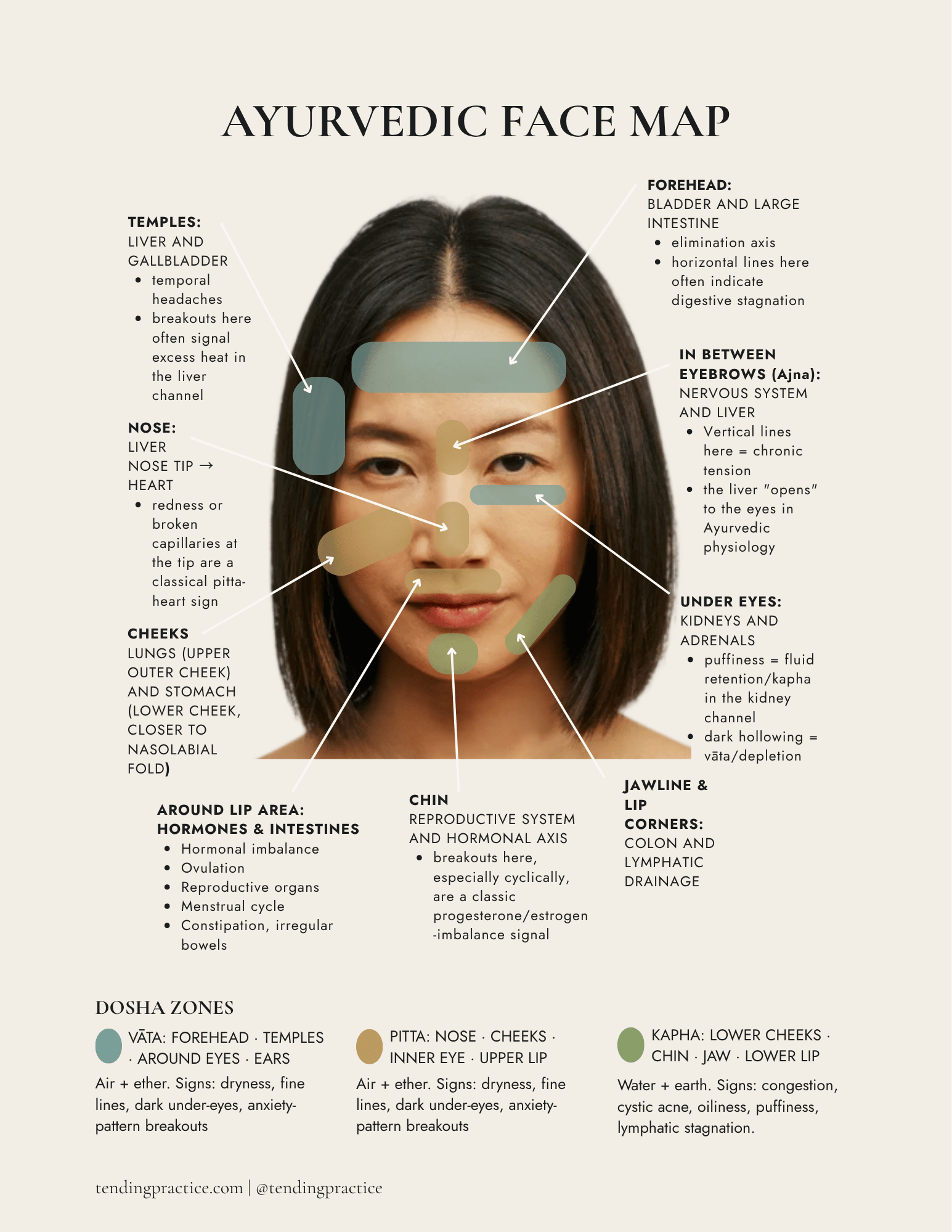
But Ayurveda mapped it first, and mapped it thoroughly. In the Ayurvedic framework, the forehead corresponds to the nervous system, digestion, and elimination. The nose relates to the heart and cardiovascular system. The cheeks correspond to the lungs and liver. The chin connects to the reproductive and hormonal systems. The area around the mouth reflects the gut. The eyes correspond to the liver and kidneys.
Using this map doesn't mean you start diagnosing. It means you start asking better questions. A client who always breaks out along the jawline and tells you her digestion has been a mess — that's a pattern worth noting. A client whose chronic undereye darkness coincides with a period of intense stress and poor sleep — same. You're not prescribing. You're listening more carefully to what the face is saying.
How Ayurvedic Skincare Differs from Conventional Esthetic Practice
Conventional Western esthetics is primarily diagnostic in a dermatological sense — we identify conditions (acne, rosacea, hyperpigmentation, dehydration) and apply corresponding treatments. This is useful and often effective. But it treats the face as the site of the problem rather than the surface where the problem becomes visible.
Ayurvedic skincare shifts the question. Instead of 'what condition does this skin have?' the question becomes 'what is this skin communicating, and what does this person need to come back to balance?' The treatment that follows is individualized in a way that no protocol-based approach can fully replicate.
This doesn't mean abandoning everything you know. Your esthetic training is valuable. The techniques you've developed over the years are real skills. Ayurveda is a lens that makes all of it more precise, more effective, and more meaningful — for your clients and for you.
Starting Points: How to Begin Integrating Ayurvedic Principles
You don't have to overhaul your entire practice or get an Ayurvedic Health Counselor certification before you can start working with these principles. Here are practical starting points:
Start with oil selection
The most immediate application of Ayurvedic principles in a facial is choosing your facial oil based on dosha presentation rather than skin type label. Dry/Vata skin gets warming, heavy oils — sesame, almond, avocado. Sensitive/Pitta skin gets cooling, light oils—coconut, rosehip, sunflower. Oily/Kapha skin gets light, stimulating oils — jojoba, sunflower, grapeseed. This is simple to implement and produces immediately noticeable results.
Add a simple dosha intake question
Add one question to your intake process: 'How would you describe your energy and stress patterns lately — scattered and anxious, hot and intense, or slow and heavy?' The answers map roughly to Vata, Pitta, and Kapha presentations. You're gathering information you didn't have before, without requiring any new paperwork.
Learn the facial zones
Print a basic Ayurvedic face map and put it where you can see it during treatments. Start noticing whether the patterns your clients present align with what the map would predict given their constitution and what they've told you about their health. The pattern recognition develops quickly once you start looking for it.
The Deeper Invitation
Here's what I want you to understand about Ayurvedic skincare that no product training will ever teach you: it is not a technique stack. It is a philosophy of seeing.
When you see through an Ayurvedic lens, you stop seeing a face with problems to fix and start seeing a person with patterns to understand. That shift changes the quality of your presence in the treatment room. It changes what you ask, what you notice, what you do with your hands, and what your clients experience.
That depth is what Iwhat keeps clients coming back, not just for the results but for the experience of being truly seen by someone who understands them.
This is the work I teach at Tending Practice — not as a surface technique but as a genuine clinical framework rooted in thousands of years of observation. If it's calling to you, you're in the right place.
→ Explore Ayurvedic Facial workshops and courses (tendingpractice.com/workshops)
→ Read about the full Ayurvedic Facials curriculum (tendingpractice.com/what-i-teach/ayurvedic-facials)
→ Join the Tending Practice Collective (tendingpractice.com/community)